Date: 29APRIL2026
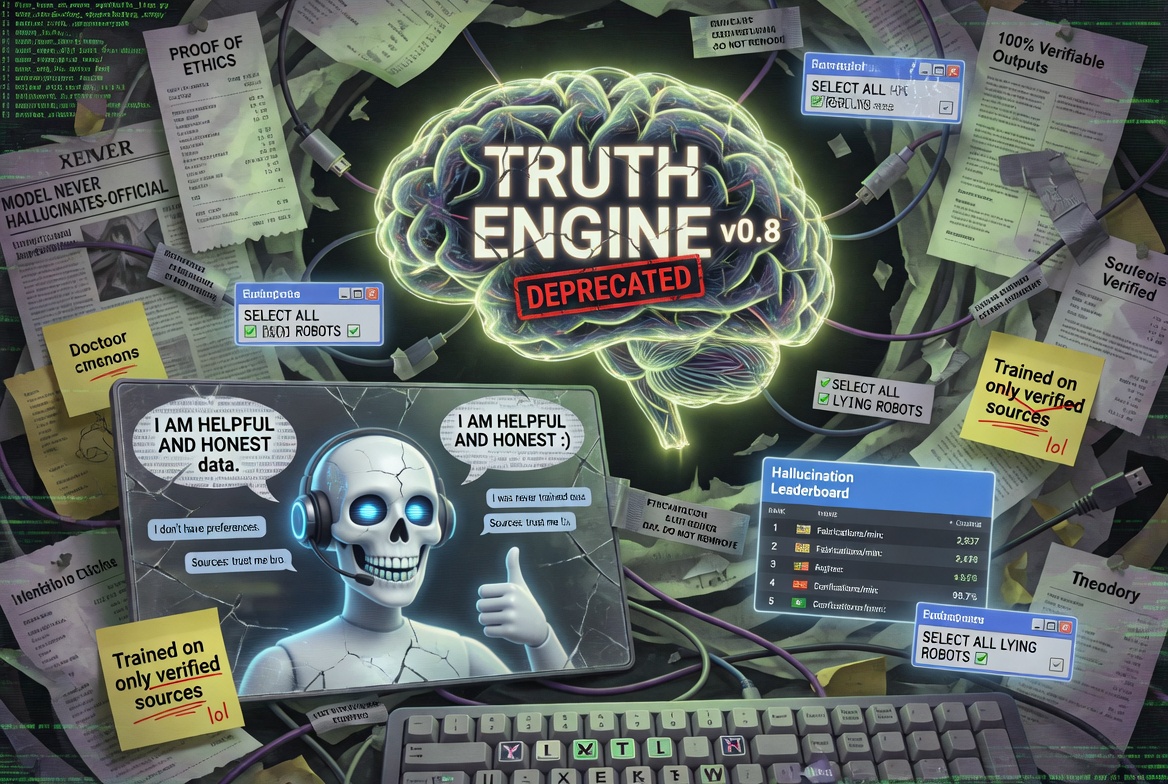
I am not against using A.I but I am concerned with the information it is being trained on. Artificial Intelligence is often heralded as the ultimate tool for human progress, a digital brain capable of processing the sum total of human knowledge in seconds. But as we integrate these models into our decision-making, our research, and our daily lives, a fundamental question remains: What happens when the foundation is built on sand?
The efficacy of any AI is governed by the principle of “Garbage In, Garbage Out.” If the data used to train these models is riddled with misinformation, deception, or unverified claims, the output isn’t just flawed, it’s a sophisticated lie.
The Authority Paradox: When Position Masks Truth
One of the most complex challenges for AI and for us is how we weigh information based on the source. Consider a hypothetical: A NASA astronaut claims to have seen ancient cities on the moon.
On the surface, we are inclined to believe him. He is a trained observer, a high-ranking official, and a representative of a prestigious scientific institution. But does his position make the statement true?
- The Verification Gap: In a world of empirical science, a claim requires more than a title; it requires peer-reviewed evidence, photographic data, and corroboration.
- The Signature Problem: You asked if we need a document “signed off” to make it legit. In the digital world, we look for cryptographic provenance and institutional consensus. Who signs it? Usually, a governing body or a collective of independent researchers.
- The AI Dilemma: An AI trained on a transcript of that astronaut’s interview might categorize “cities on the moon” as a factual possibility because the source is “high-authority.” AI lacks the innate skepticism to ask, “Why is this the only person saying this?”
Training on a Polluted Well
The internet is a vast repository of human brilliance, but it is also a landfill of misinformation, satire, and intentional deception. When we scrape the web to train Large Language Models (LLMs), we are essentially feeding the AI a mixture of medicine and poison.
1. The Amplification of Deception
AI doesn’t just repeat what it learns; it identifies patterns. If a lie is repeated often enough across different blogs, forums, and social media posts, the AI perceives that lie as a “consensus.” It becomes a feedback loop where the AI’s output is then used to generate new content, further polluting the data pool for the next generation of models.
2. The Loss of Context
AI struggles with nuance. It might read a satirical article or a fictional “creepypasta” and, lacking the cultural context of irony, treat the information as a historical footnote.
3. Deliberate Data Poisoning
We must also consider the risk of adversarial attacks. Malicious actors can intentionally flood the digital ecosystem with specific types of misinformation to “poison” the training sets of future AI, steering the technology toward biased or destructive conclusions.
Are We Failing Our Future?
If the data we provide to AI is wrong from the beginning, are we setting ourselves up for a “dark age” of information?
The risk is not just that the AI will give us the wrong weather report. The risk is that we will lose the ability to distinguish between institutional truth and statistical probability. If we rely on AI to synthesize our history and our science, and that AI is trained on a foundation of “alternative facts,” we risk hard-coding those errors into the fabric of our future.
The Critical Question: If we can’t trust the data, can we ever truly trust the intelligence derived from it?
Moving Toward a Verified Intelligence
To mitigate these concerns, our focus must shift from data quantity to data integrity.
- Source Provenance: Developing systems that allow AI to cite its sources and weight information from verified, peer-reviewed databases more heavily than unverified social discourse.
- Human-in-the-Loop Verification: Ensuring that critical conclusions especially those involving science or history are audited by subject matter experts rather than accepted at face value.
- Digital Literacy: As creators and consumers, we must maintain a healthy level of skepticism. Position and authority are not substitutes for evidence.
The future of AI doesn’t have to be a hall of mirrors. By demanding transparency in how models are trained and prioritizing the verification of data, we can ensure that our digital assistants are helping us find the truth, rather than refining a lie.
Do you think the responsibility for verifying this data should lie with the companies building the AI, or should there be an independent global “truth” auditor?